For two years, a purpose-built cannabis production facility in Crossfield, Alberta, sat empty.
The facility had all the infrastructure of a large-scale growing operation — a header house, climate controls, advanced growing systems, and a significant greenhouse footprint — but no crops, no employees, and no clear future.
In August 2025, Energro acquired the vacant facility with a different vision: retrofit it for fresh food production.
What was once a symbol of Alberta's cannabis boom-and-bust cycle is now being reimagined as a local food production hub — powered by recovered energy, circular thinking, and Alberta-made materials.

Built From the Ashes of the Green Rush
To understand why a facility like this was available in the first place, it helps to look back to 2018, when Canada legalized recreational cannabis.
The years that followed saw significant investment in large-scale cannabis infrastructure, including purpose-built greenhouses and controlled-environment agriculture facilities. Alberta became one of the major centres of this expansion, supported by its agricultural expertise, available land, and energy resources.
However, the market did not develop as many investors anticipated. Cannabis production capacity quickly exceeded demand, creating a supply imbalance that contributed to declining prices and mounting pressure on operators. Combined with regulatory complexity, high operating costs, and shifting market conditions, many large-scale cannabis facilities across Canada were eventually closed, sold, or left unused.
The Crossfield facility was one of those assets.

Energro recognized that the infrastructure itself was never the problem. The greenhouse had been purpose-built with valuable agricultural assets — including greenhouse space, climate control systems, irrigation, and established utilities — that could support a different kind of production.
In August 2025, Energro acquired the facility and began retrofitting it for fresh food production.
Rather than building a new greenhouse from the ground up, Energro is giving existing agricultural infrastructure a second life by transforming a former cannabis production facility into a local food production operation serving Alberta communities.
Turning Waste Heat and CO₂ Into Something Useful
One of the most innovative aspects of Energro's approach is the integration of energy production with agriculture.
The greenhouse is connected to an on-site natural gas power generation project that captures and reuses resources that would otherwise be lost. Waste heat generated through power production is redirected to warm the greenhouse, while recovered CO₂ is cleaned and recaptured to enrich the growing environment, helping plants thrive.
The result is a more circular system where energy production and food production support one another.
For a facility originally designed for cannabis cultivation, retrofitting it for food production required rethinking nearly every aspect of the growing process — from crop selection and labour requirements to the materials supporting plant growth.
That includes the growing medium.
Why the Growing Medium Matters
This is where TerraFibre enters the story.
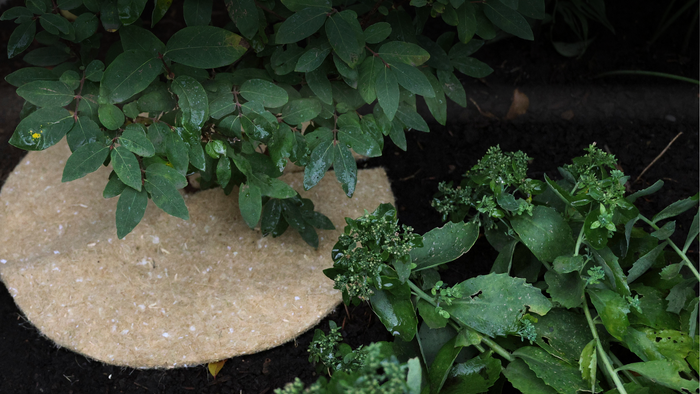
TerraFibre is our growing-media brand, developed here at BioComposites Group (BCG) — an Alberta-based hemp manufacturing company dedicated to transforming Canadian industrial hemp into high-performance, sustainable products. Made from Canadian-grown industrial hemp, the fibre is processed, cleaned, separated, and needle-punched without glues or synthetic binders.
The result is a natural, durable material with excellent water retention, a neutral pH, and the ability to biodegrade at the end of its useful life.
At Energro's Crossfield greenhouse, coconut coir remains the primary growing medium. Rather than replacing the coir itself, TerraFibre plays a supporting role in strawberry production by wrapping around the coir plug and securing it within the vertical growing towers.

This application provides several practical benefits:
Structural support: The strong, needle-punched hemp fibre securely holds the coir plug in place throughout months of irrigation and production, maintaining the integrity of each growing tower.
Reduced plastic use: The biodegradable hemp fibre replaces synthetic liners or sleeves that would otherwise become waste after each growing cycle.
More Canadian inputs: Using locally manufactured hemp fibre reduces reliance on imported or petroleum-based materials.
While TerraFibre is just one component within a much larger greenhouse system, it demonstrates how Alberta-grown materials can contribute to more sustainable horticultural practices.

The Company Behind the Mats
TerraFibre is our growing-media brand, developed here at BioComposites Group (BCG) — an Alberta-based hemp manufacturing company dedicated to transforming Canadian industrial hemp into high-performance, sustainable products.
Founded on the belief that locally grown, natural materials can outperform conventional alternatives, we manufacture hemp-based solutions for a wide range of industries.
Today, our innovations include:
- Horticulture and growing media
- Erosion control products
- Construction materials
- Hempcrete applications
- Automotive components
- Natural fibre insulation
At the core of these products is the concept of waste valorization — finding value in agricultural materials that might otherwise go unused.
Industrial hemp is particularly well suited to this approach. It matures in approximately 100 days, requires relatively few agricultural inputs, supports soil health, and produces multiple valuable fibre streams that can be utilized across numerous applications.
Working with hemp growers across the Canadian Prairies, we process and manufacture our products right here in Drayton Valley — creating Canadian-made solutions from Canadian-grown agricultural resources.

That philosophy closely mirrors what Energro is accomplishing in Crossfield. While Energro has transformed a vacant cannabis greenhouse into a food production facility, we are demonstrating how renewable agricultural materials can replace conventional products with sustainable, high-performance alternatives. Together, we highlight how innovation, local resources, and circular thinking can create new economic opportunities, strengthen regional supply chains, and build a more sustainable future.
A Local Food Story, Not Just an Energy Story
It is easy to focus on the headline: a former cannabis greenhouse becoming a food production facility.
But the larger story is about resilience, innovation, and resourcefulness.
Energro's Crossfield greenhouse is currently producing leafy greens, tomatoes, and strawberries, with strawberry production expected to expand significantly as operations scale. The facility is also utilizing only a portion of its available growing space, leaving substantial capacity for future expansion without requiring new construction.
Additional greenhouse expansion plans are already underway, signalling that this is more than a pilot project. It is a model for how Alberta can rethink underutilized infrastructure, strengthen local food production, and build more circular agricultural systems. The greenhouse itself does not care whether it grows cannabis or vegetables. The energy systems do not care whether they support flowers or food. The opportunity lies in recognizing the value of infrastructure that already exists and giving it a new purpose. Energro's Crossfield operation will not replace all of Alberta's food imports, but it demonstrates what is possible when existing infrastructure, innovative energy systems, and locally manufactured materials come together.
A vacant greenhouse has become a source of fresh food. Alberta hemp has become part of the solution. Together, they demonstrate how yesterday's surplus infrastructure can help build tomorrow's more resilient, sustainable food system.