The beds are done. The tomato plants came out weeks ago, the garlic is in and covered, and the hose is coiled in the garage until April. Every gardening article you read between now and March will be about planning: order your seeds, sketch your beds, read a book, wait.
That advice is fine. It is also five months long.
Here is the part nobody mentions. There is one edible crop you can grow all the way through winter, in a space the size of a cookie sheet, with no grow lights, no soil and no greenhouse. You can start one this week and be cutting from it in just 10 days.
Why microgreens work in winter when nothing else does
Put a lettuce seedling on a windowsill in November and watch what happens. It germinates, then stretches — pale, thin and reaching — and never amounts to anything. The problem is light. By the middle of November, most of the northern half of the continent is down to ten hours of daylight or fewer, and what there is comes in weak and low-angled. A plant that needs to build a head, a fruit or a root needs far more than that.
Microgreens never get to that stage. You harvest them at seven to fourteen days, when they have their first true leaves and are still living mostly off the energy stored in the seed. They are cut long before light becomes the thing holding them back.
That is the whole trick, and it is why microgreens are the one crop that genuinely does not care that it is November. The same windowsill that kills a lettuce plant grows a tray of pea shoots perfectly well.
You need less room than you think
A standard 10″ × 20″ tray takes up about 1.4 square feet. That is slightly smaller than a cookie sheet.
Places that is small enough to fit:
• A kitchen windowsill, if it's a reasonably deep one
• The end of the counter, next to the kettle
• A bookshelf by a window
• The top of the fridge, if the window is close enough
• A card table in a spare room
And if that is still too much, the 5″ × 5″ size is about the footprint of a side plate. People grow them in apartments with one north-facing window.
There is no soil involved, which is the part that usually decides it. Growing indoors normally means a bag of potting mix in the hall closet, dirt on the counter, and fungus gnats drifting around the living room by February. A hemp grow mat is a dry pad of fibre. It comes out of the bag clean, it goes into the tray clean, and when the tray is finished the whole thing goes in the compost. Nothing gets tipped down a drain and nothing gets stored.
What to grow first
If this is your first winter tray, start with pea shoots. They are forgiving, they germinate fast, they produce more volume than anything else on the list, and they taste like fresh garden peas, which is a genuinely startling thing to eat in November.
After that:
|
Variety |
Ready in |
Tastes like |
Notes |
|
Pea shoots |
8–12 days |
Sweet, grassy, like raw peas |
The most forgiving. Highest yield by weight. |
|
Sunflower |
8–12 days |
Nutty, crunchy, substantial |
Needs the seed hulls picked off as they lift. Worth it. |
|
Radish |
6–9 days |
Hot and peppery |
The fastest. Good when you want something to happen quickly. |
|
Broccoli |
8–12 days |
Mild, faintly cabbagey |
Fine, delicate leaves. Mild enough for people who don't like "green" flavors. |
A note on honesty: some varieties genuinely do struggle in a dim room. Basil and other herb microgreens are slow and sulky at the best of times, and in the depths of winter they will test your patience. Leave those for March. The four above will all finish in a dim kitchen without complaint.
What you actually need
Four things, and you probably own two of them.
1. A tray. A 10″ × 20″ seed tray, or honestly a baking dish. It needs to hold a little water, not drain.
2. A hemp grow mat cut or sized to the tray. This is the growing medium, in place of soil.
3. Seed. Microgreen seed, sold by weight. A pound of pea seed is a lot of trays.
4. Water. Tap water is fine. But check the pH of your water. If your tap water isn't close to neutral, around 7.0, you may have trouble germinating seeds or growing healthy seedlings. Test your tap water before use, and if it falls outside the ideal range, use pH-adjusted or filtered water.
No grow lights. No heat mat. No fertilizer — everything the plant needs for its first two weeks is already in the seed. If you want to add a light later because you've got the bug, go ahead, but you do not need one to start, and that is the point.
We have the full seed-to-harvest walkthrough here if you want every step in detail.
What the ten days look like
So you know what you're signing up for.
Day 1. Soak the mat, spread the seed across it, cover the tray with something that blocks light — another tray, a tea towel, a cookie sheet. Put it somewhere out of the way. It does not need the window yet.
Days 2–3. Nothing visible, then roots. Keep it covered and damp.
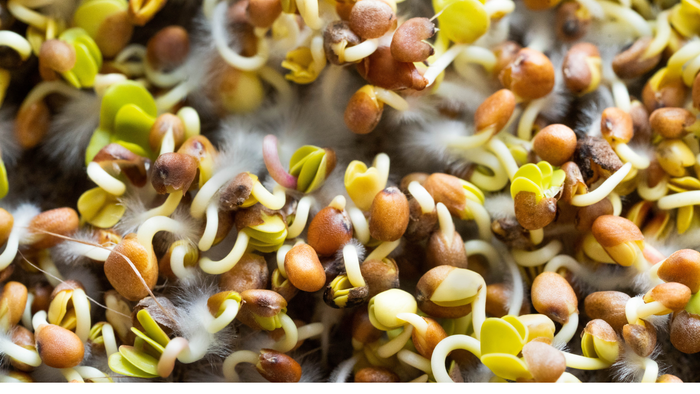
Days 3–5. Pale yellow shoots lifting the cover. This is the stage that makes people take photographs. Uncover and move it to the window.
Days 5–7. The yellow turns green within hours of hitting daylight. Even weak November daylight.
Days 8–12. First true leaves. Cut with scissors just above the mat, rinse, eat.
Then the mat goes in the compost and the tray gets refilled. The whole cycle is shorter than the gap between grocery shops.
Start one this weekend
The case for doing it now rather than in February is simple: November is when you still remember what a garden feels like, and February is when you have given up. A tray on the counter is a small thing, but it is a green, growing, edible thing in a month when there are none of those outside.
It also means that when the seed catalogs land in January, you will not be reading them with the whole winter still ahead of you. You will be cutting something.
Made in Drayton Valley, Alberta, from Canadian hemp. No synthetic binders, and the mat composts when the tray is done.